Tuesday, 9 May 2006

Cool optical illusions

I'm a big fan of optical illusions. And I just found a blog devoted to them, from which I copied the remarkable image shown here. I got there from Blogs of Note, which features daily links to "Interesting and noteworthy Blogger-powered blogs, compiled by the Blogger Team." Their archives go back more than 5 years—great for semi-random web surfing!

By the way, for more cool optical illusions, I'd recommend the book Incredible Visual Illusions by Al Seckel.

Monday, 8 May 2006

Disclaimer

The views and opinions I express on this blog are mine, and not those of my employers, clients, family, or friends, past or present. This blog is in no way affiliated with my employers, clients, family, or friends, past or present.

The information and content on this blog are provided "as is" with no warranty of any kind, either express or implied.

Links

I cannot guarantee that webpages I link to will work all of the time and I have no control over the content of linked pages. I am not responsible for the contents of any linked websites and do not necessarily endorse the views expressed on them. The fact that I link to a given website does not mean that I endorse the contents of that website.

Comments

I welcome comments, but reserve the right to delete comments as I see fit. Comments represent the views and opinions of those who post them, and I do not necessarily endorse these views and opinions.

Sunday, 7 May 2006

Miscellany

It's Sunday evening, and rather than coming up with something thoughtful myself, here are some miscellaneous items of interest. A cornucopia if you will, as illustrated at left.

First, something important—an urgent appeal from Amnesty International Canada:
On May 9th the U.N. General Assembly will elect the members of the new UN Human Rights Council.

Canada, which is standing for election, has a critical role to play in ensuring that the Council's mandate of protecting all human rights for everyone is not a hollow promise.

Send an email to Canada's Minister of Foreign Affairs, the Honorable Peter MacKay, and urge him to ensure Canada demonstrates clear leadership in the respect and fulfillment of human rights norms and standards.

Take action before May 9th!
If you're in a science-and-public-communication mood, this post is worth reading.

Next, something fun (via Antonella Pavese's interesting blog): a very entertaining manifesto on how to be creative by advertising executive and blogger Hugh MacLeod.

Incidentally, Antonella Pavese recommends this cleverly-named, free, online, task manager: remember the milk. Ok, I haven't actually tried it, but their symbol is just too cute.

Wednesday, 3 May 2006

A view of evidence

In the last month I've discussed various aspects of the evidence-based debate. I'd now like to present some of my ideas on the subject. As I've suggested previously, the definition of evidence seems to lie at the heart of the dispute. But before I attempt to define evidence, I think it's useful to consider the word itself.

Evidence is the noun form of the adjective evident, ultimately deriving from the Latin evidens from ex- (out, forth) + videre (to see). The Oxford English Dictionary gives the following definitions for evident: "1. a. Conspicuous b. Obvious to the sight. 2. Clear to the understanding or the judgement; obvious, plain. 3. Indubitable, certain, conclusive. —1653." And the primary definition of evidence is simply "The quality or condition of being evident."

So a very literal interpretation would take evidence to be what can be seen, or "shown forth". It seems natural to extend this beyond vision to sense perceptions in general. Further metaphorical extensions bring us to the notion of clarity, certainty, and conclusiveness. And already the problem becomes apparent: we have moved from sense perceptions to things that might be considered similarly certain and conclusive. Like what? Deductive arguments? Accepted theory? Long experience? Expert opinions? Religious precepts?

Let's consider each of these in turn, starting with deductive arguments. A valid deductive argument is water-tight—provided that its premises are true. But how do we establish them? Perhaps we can depend on accepted theory. But history is littered with theories that were once universally accepted, but are now discredited or superseded. Of course there's always long experience. Experience is the cumulative product of personal practice and observation. But it is notoriously subject to selection bias (and perhaps other biases too). And when it comes to rare events, no amount of experience is sufficient. Can expert opinion step into the breach? The opinion of an expert represents a synthesis of many different sources of information, usually carried out over many years. While there may be many good reasons to trust an expert (such as his or her qualifications, intelligence, experience, and good standing in the community), well-meaning experts have been spectacularly wrong any number of times. Ultimately trusting expert opinion is an act of faith. Which nicely brings us to religious precepts as a source of certainty. These are perhaps the original "self-evident" truths—that is, to the believer, but perhaps to nobody else.

It is, of course, true that sense perceptions can be misleading too. A classic example is the straight stick that appears bent when placed in a glass of water due to the refraction of light. Any number of other illusions and hallucinations make interpretation of sense perceptions a thorny philosophical problem—one of the fundamental challenges in epistemology. Without wishing to minimize these, I will set them aside, by simply asserting that we know the external world through our sense perceptions. They are the only raw materials at our disposal, and they are the closest we can get to certainty about the external world. Evidence is observational.

But that doesn't mean that observation is all there is to evidence. For instance, a scientific experiment involves action (manipulating or controlling conditions) as well as observation. But if there's no observation, there's no evidence. To consider a particular example, this means that opinion doesn't count as evidence, but observation of opinion does! That is:
  • Opinion about X isn't evidence about X.
But
  • Observation of opinion about X is evidence about opinion about X.
I certainly don't mean to imply that opinion is worthless—that would be a bit self-defeating, now wouldn't it?—but it just can't be counted as evidence. In any case, regardless of what I or anyone else has to say, opinion will always guide us.

Ultimately, I think that opinion is most convincing when it is backed up—whether by deductive argument, theory, experience, evidence, or some combination of these. And I hope that my opinions have some of these supports.

While I haven't yet given a definition of evidence, I have presented what I think is a crucial qualification: evidence is observational. But there's a lot more to it than that!

Saturday, 29 April 2006

Probably incorrect probability

A recent post on the blog Blackademic about the alleged rape of a black woman by white Duke university lacrosse players generated a flurry of comments. One of them anonymously argued:
"Unfortunately, statistically a black women is significantly more likely to make a false accusation of rape than to have been raped by a white man. According to the National Crime Victimization Survey ( http://www.ojp.usdoj.gov/bjs/pub/pdf/cvus/current/cv0342.pdf ), less than .0004% of black rape victims were raped by whites. (The NCVS reports the percentage as 0% because there were less than 10 reported cases. I assumed 9 cases, to come up with an actual percentage) Even with the most conservative figure of 2% of rape allegations being false, this means in the case of the Duke Rape Case, the victim is 5000 times more likely to have made a false accusation than to have actually been raped."
There were some perplexed responses to this dramatic claim:
  • "yeah, cuz stats and figures are ALWAYS correct--whatever. it depends on who did the survery and for whom."
  • "How did you come up with the 5000 times more likely figure? That makes no sense at all. Using the figures you cited, the victim regrdless of race is likely to be lying only 2% of the time."
  • "Even if this study were accurate, and even if it were ethical to invoke the laws of probability to determine whether someone is believable-- two outsized ifs-- one coin, landing heads up, doesn't determine the likelihood of the next coin landing heads up. Neither does one woman, 30 years ago, have any bearing on the likelihood that another woman is telling the truth."
  • "the statistics and logic are just that - excercises in probability that tell us nothing about the case in question, because they are not equal to evidence."
But I think these responses miss the point: as far as I can see, the claim is simply incorrect. I think my reasoning is correct, but if I've slipped up please leave a comment.

First, Anonymous claimed that "less than .0004% of black rape victims were raped by whites." I followed the link to the National Crime Victimization Survey to check on this. The total number of rapes or sexual assaults of blacks listed was 24,010 and based on "about 10 or fewer sample cases" the perceived offender was white 0.0% of the time. I'm not entirely sure what this means, but Anonymous reasoned that as many as 9 of the offenders might be white. Now 9 out of 24,010 is about 0.04%, not 0.0004%. Anonymous then introduces "the most conservative figure of 2% of rape allegations being false". Dividing 2% by the incorrect figure of 0.0004%, Anonymous claims that "the victim is 5000 times more likely to have made a false accusation than to have actually been raped". If we divide 2% by the correct figure of 0.04%, we get 50 not 5000!

But apart from this error, the interpretation of the ratio is wrong. For it to be right, we would have to know the probability that the woman was raped. But that's not what the 0.04% represents. Instead, it's an estimate of the probability that if a black person is raped, the offender is white.

So the whole thing is invalid. The problem isn't with probabilistic reasoning per se, it's with faulty probabilistic reasoning. And that's a shame when something so important is at stake.

Monday, 24 April 2006

The thrust and parry of the evidence-based-medicine debate

The debate around evidence-based medicine (EBM) makes for fascinating reading, not least because of the prevalence of hyperbole. In a 2004 paper (it's not open access, but here is the reference), Massimo Porta writes:
"Common sense should build upon a body of evidence and experience accrued over the centuries and shared by the medical community. That some members of the community have made it their task to define which parts of the collective experience constitute evidence and which have less title to reach above water has contributed to the current state of affairs. EBM acolytes now perceive practitioners as grubby underlings, hopeless at applying the latest (evidence-based) literature. Clinicians, resentfully, feel watched by nerds who spend their time sipping coffee while talking to computers instead of patients."
Ow! He continues:
"When it began, it all sounded rather sensible: treatments should be tested for efficacy and trials should be controlled, randomized, double-masked and sufficiently powered. Procedures that do not pass muster should not be recommended for use in clinical practice and self-respecting, commonsensical doctors should refrain from adopting them anyway. But then epidemiologists, statisticians and librarians saw power befalling them as they trotted unexplored avenues towards number crunching."
Given my recent post, I was rather amused by his references to power-hungry number crunchers! In part he was responding to a tongue-in-cheek article in the 2002 holiday issue of BMJ, which purports to reveal the 10 commandments of evidence based medicine:
  • Thou shalt treat all patients according to the EBM cookbook, without concern for local circumstances, patients' preferences, or clinical judgment
  • Thou shalt honour thy computerised evidence based decision support software, humbly entering the information that it requires and faithfully adhering to its commands
  • Thou shalt put heathen basic scientists to the rack until they repent and promise henceforth to randomise all mice, materials, and molecules in their experiments
  • Thou shalt neither publish nor read any case reports, and punish those who blaspheme by uttering personal experiences
  • Thou shalt banish the unbelievers who partake in qualitative research, and force them to live among basic scientists and other heathens
  • Thou shalt defrock any clinician found treating a patient without reference to all research published more than 45 minutes before a consultation
  • Thou shalt reward with a bounty any medical student who denounces specialists who use expressions such as "in my experience"
  • Thou shalt ensure that all patients are seen by research librarians, and that physicians are assigned to handsearching ancient medical journals
  • Thou shalt force to take mandatory retirement all clinical experts within a maximum of 10 days of their being declared experts
  • Thou shalt outlaw contraception to ensure that there are adequate numbers of patients to randomise.
The humour and inflated language aside, there are some big issues here. For example, is it appropriate to hold up the randomized controlled trial (RCT) as the "gold standard of evidence" and relegate basic science to an inferior position? The authors of a philosophical analysis of the evidence-based medicine debate argue that:
"Statistical information from an RCT is virtually uninterpretable and meaningless if stripped away from the backdrop of our basic understanding of physiology and biochemistry."
Compare this with what one of the originators of evidence-based medicine has to say:
"In many [cases], empirical solutions, tested by applied research methods, are "holding the fort" until basic understanding—of mechanisms and interventions—is forthcoming."
This is just a small sampling. The debate about evidence-based medicine and more generally the evidence-based movement is huge. And with good reason: there's an awful lot at stake.

Sunday, 16 April 2006

Pyramid power?


In my second-last post, I discussed the recent controversy over the term "evidence-based". It was popularized through evidence-based medicine, an enormously influential movement spearheaded in the early 1990's by epidemiologists at McMaster University (see accompanying picture of main campus). It certainly sounds reasonable to suggest that medicine (or healthcare more broadly, or education, or policy ...) should be evidence-based, but what does it mean? Here, repeating from my last post, is probably the best known definition of evidence-based medicine:
"the conscientious, explicit, and judicious use of current best evidence in making decisions about the care of individual patients."
Clearly the first step in making sense of this definition is to sort out what evidence is.

But is it really important to define evidence? Isn't it just semantics? Well, I think it does matter—for two reasons. First, there's been a widespread push for evidence-based practice and policy. Funding bodies and organizations are giving priority to "evidence-based" approaches and initiatives, and that can have a substantial impact on what research gets done and what practices and policies get implemented. Second, if evidence is not clearly defined, how can we define what "current best evidence" is?

The attempt to delineate different "levels of evidence" has been an ongoing preoccupation of evidence-based medicine. The notion is that some study designs provide more valid or reliable evidence than others, and that there is a "hierarchy of evidence", often depicted as a pyramid such as this one:
(source)
It's not hard to see why this engenders so much heated debate. For example in the figure above, "in vitro ('test tube') research" ranks below "ideas, editorials, opinions"! But this is only one of several such evidence hierarchies, which have notable differences.

For example, the figure below makes no mention at all of benchtop science, and puts "evidence guidelines" higher than randomized controlled trials (RCTs):(source)
As with the previous pyramid, meta-analyses and systematic reviews appear, but here Cochrane systematic reviews are judged best of all ("the 'Gold Standard' for high-quality systematic reviews").

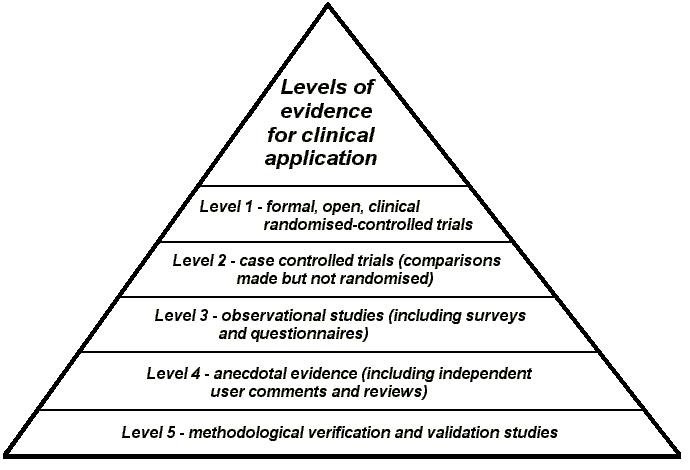
Here's one more pyramid, which doesn't include systematic reviews, but does include anecdotal evidence:
(source)
There are lots of other evidence hierarchies, for example the Oxford Centre for Evidence-based Medicine Levels of Evidence, which makes distinctions according to what the evidence is about (e.g. therapy versus diagnosis).

Distilling the different types of "evidence" from these hierarchies suggests that, according to the authors, evidence may include various types of: (1) empirical studies, (2) summaries of empirical studies, and (3) opinions (hmmm ...). But it's certainly clear that there isn't complete consensus on exactly what qualifies in each of these categories, nor on the rankings.

Perhaps all these pyramids haven't been built on the strongest foundations?